Vegas Homeowner Guide
A new condenser shouldn’t fold in two Vegas summers. When it does, the install is almost always the cause — not the equipment. The real fix is a correctly done AC installation, performed to spec the first time. Here are the four shortcuts we find on most of these calls.
Line sets brazed without nitrogen
System never properly vacuumed
Refrigerant charged by feel, not by weight
Line set or ductwork mismatched to the new system
Check any that match. Two or more, and it’s time for a diagnostic – not another guess.
These four causes account for most calls like this we run across the Las Vegas Valley – Summerlin, Henderson, Spring Valley, and everywhere in between.
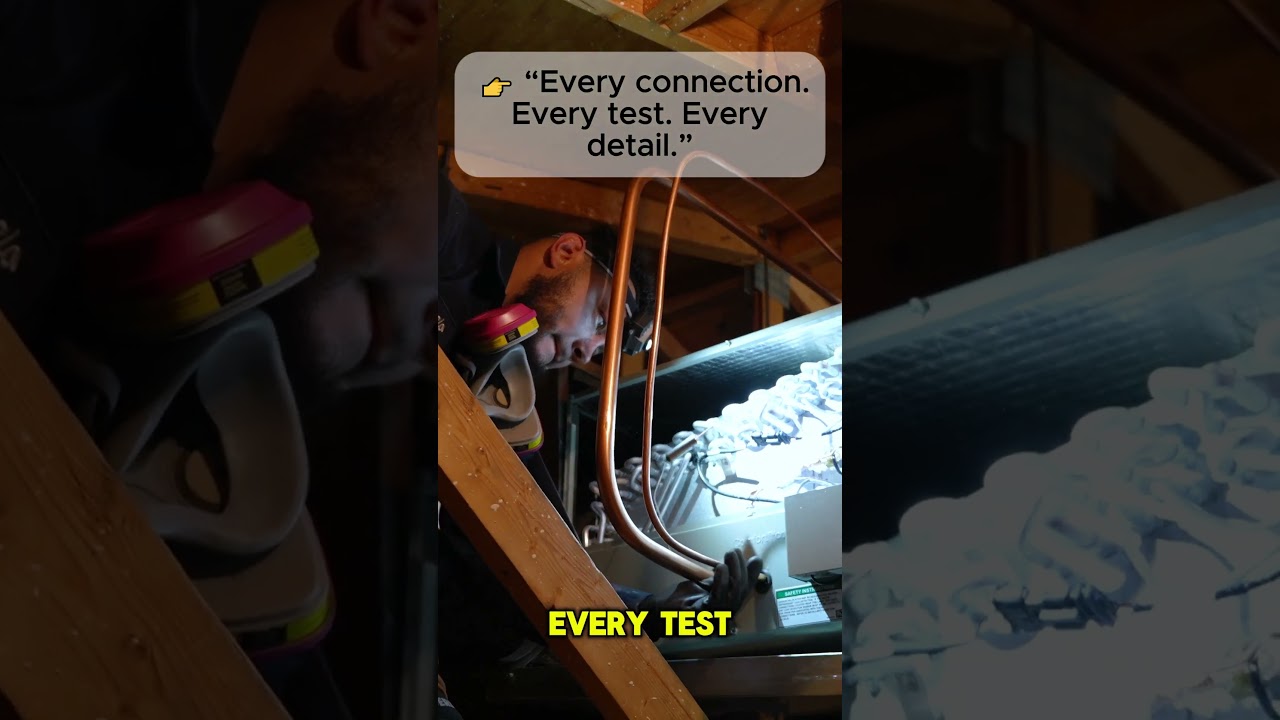
When techs braze copper without nitrogen flowing through the line, oxidation flakes off inside the pipe. Those flakes ride the refrigerant straight into the metering device or compressor and shorten the system’s life by years. You can’t see it from outside. You feel it 18 months later, when the first big repair bill lands.
A proper vacuum pulls the line set down to 500 microns and holds. Shortcut installs run the pump for 5 minutes and call it done. The trapped moisture turns to acid inside the system, eats the copper from the inside, and kills compressors — usually right after the manufacturer warranty expires.
Vegas heat hides undercharge and overcharge symptoms differently than humid climates do. If your installer didn’t weigh refrigerant in — or use superheat and subcooling measurements — your system has been running outside spec since day one. Cooling capacity drops 10–15%. On a 4-ton system running 12 hours a day in July, that’s roughly $40–60 a month vanishing into the wrong charge.
Matching the condenser to the air handler is only half the job. If the line set diameter doesn’t match the run length, or if the original ductwork can’t handle the new system’s airflow, you lose 15–25% of rated capacity before the air ever reaches your vents. We see this most often on changeouts in Summerlin, Anthem, and pre-2010 Henderson builds – the ductwork was sized for an 80% efficient 3-ton, and now it’s choking a 4-ton 16 SEER2.
From Summerlin to Henderson, here is how we’re keeping homes across the Las Vegas Valley cool and comfortable.
Our team recently completed a full HVAC installation in Henderson, upgrading a residential system to a 4-ton RunTru by Trane split system.
View Project
At Bob’s Repair, we help homeowners in Henderson improve energy efficiency and indoor comfort by upgrading attic insulation.

We installed a 16 amp soft start to help reduce inrush current and improve the performance of the system.
We diagnose on-site, photograph what we find, and walk you through it before we recommend a single repair.
Every part and labor line itemized before we start. If we find something extra mid-job, we stop and call you before adding a dollar.
We fix the part that's failing. If a $40 capacitor solves it, that's the job — not a $1,200 replacement you didn't need.
We run the system, take a reading, and confirm the symptom that brought us out is gone. If it isn't, we stay and keep working.
Redesign of the “What we see in Vegas homes” section on why-is-my-upstairs-so-hot. Four side-by-side cards become one-video-per-row so each Short gets a real on-page summary beside it. Embeds are click-to-load facades (try clicking a thumbnail — the player only loads on click, keeping the page fast). Copy is the client’s approved blurbs, trimmed to 2–3 sentences. Everything is real DOM text.
Short clips from real service calls across the Valley. The problem, the diagnosis, the fix.
Even with a brand-new AC, the upstairs still sat at 80°. The real problem wasn’t the unit — it was the attic: poor ductwork and thin insulation let cold air (and money) escape before it ever reached the second floor. Rebuilding the attic the right way is what keeps the whole house cool.
Watch on YouTubeA brand-new AC still couldn’t cool the upstairs, because new equipment can’t fix a bad building envelope. In Las Vegas, attics hit 160°F+, and most townhomes were built with only the bare-minimum insulation to pass code. Upgrading insulation to proper levels stops the heat pouring in from above.
Watch on YouTubeThe “forbidden ice cream” in your attic is blown-in insulation — and most Las Vegas homes don’t have nearly enough. Without it, the air you paid to condition rises straight through the ceiling and escapes. Topping the attic off to R-49 acts like a thick thermal blanket, keeping cool air in your bedrooms instead of the sky.
Watch on YouTubeThe AC was loud and struggling but not broken — it couldn’t breathe. An undersized return opening was choking the blower motor, like running a marathon while breathing through a straw. Cutting, enlarging, and sealing the blower door lowered static pressure: a simple airflow fix that boosts efficiency and protects the compressor.
Watch on YouTube